Expert Guidance on Tree Cutting Near Power Lines in Cape Town
Understanding the Risks of Tree Cutting Near Power Lines
Working with trees that have grown into or near electrical infrastructure is one of the most dangerous tasks in arboriculture. In Cape Town, where the urban canopy meets a complex network of overhead cables, property owners often face the challenge of managing overgrown branches without putting themselves or others at risk. Tree cutting near power lines is not a job for general gardeners or DIY enthusiasts. It requires specific training, the right equipment, and a deep understanding of both electrical safety and tree biology.
Every year, Eskom and the City of Cape Town respond to outages caused by branches contacting live wires. During strong south-easterly winds, a seemingly stable limb can shift and break a conductor, leading to power failures and fire hazards. Beyond the inconvenience of a blackout, the real danger is electrocution. A chainsaw or pole saw touching a live line can kill the operator instantly. Even a branch that is not touching the wire can become conductive if it is wet or if the voltage arcs across a gap. This is why professional arborists treat every tree near a power line as a potential electrocution hazard.
The Legal and Regulatory Framework
In the Western Cape, vegetation management near electrical infrastructure is governed by strict municipal by-laws and national occupational health and safety regulations. The City of Cape Town requires that any tree cutting near power lines be carried out by qualified line clearance crews or under the supervision of a certified arborist. Homeowners cannot simply hire a handyman with a chainsaw. The law demands a power line clearance distance of at least three metres for unqualified workers, and for trees within that zone, only authorised contractors may work.
Eskom, as the primary electricity supplier in the region, has its own clearance standards. They recommend a minimum safety zone of 1.5 metres around any conductor, but this varies with voltage and weather conditions. A tree risk assessment is often required before work begins, especially if the tree is large or in a difficult position. The Western Cape Government also encourages property owners to report dangerous trees through official channels, rather than attempting to trim them alone. Ignoring these rules can result in fines, liability for damages, and, more importantly, serious injury or death.
When to Call a Professional Arborist
Not every tree near a power line needs to be removed. Often, selective pruning is enough to maintain safe clearance while preserving the tree's health and appearance. A skilled arborist will assess the species, growth pattern, and structural integrity before deciding on the best approach. For example, a fast-growing gum tree may need annual maintenance, while a slow-growing indigenous olive might only require attention every few years. The decision between tree felling and pruning depends on the tree's condition, its proximity to the line, and the risk of future interference.
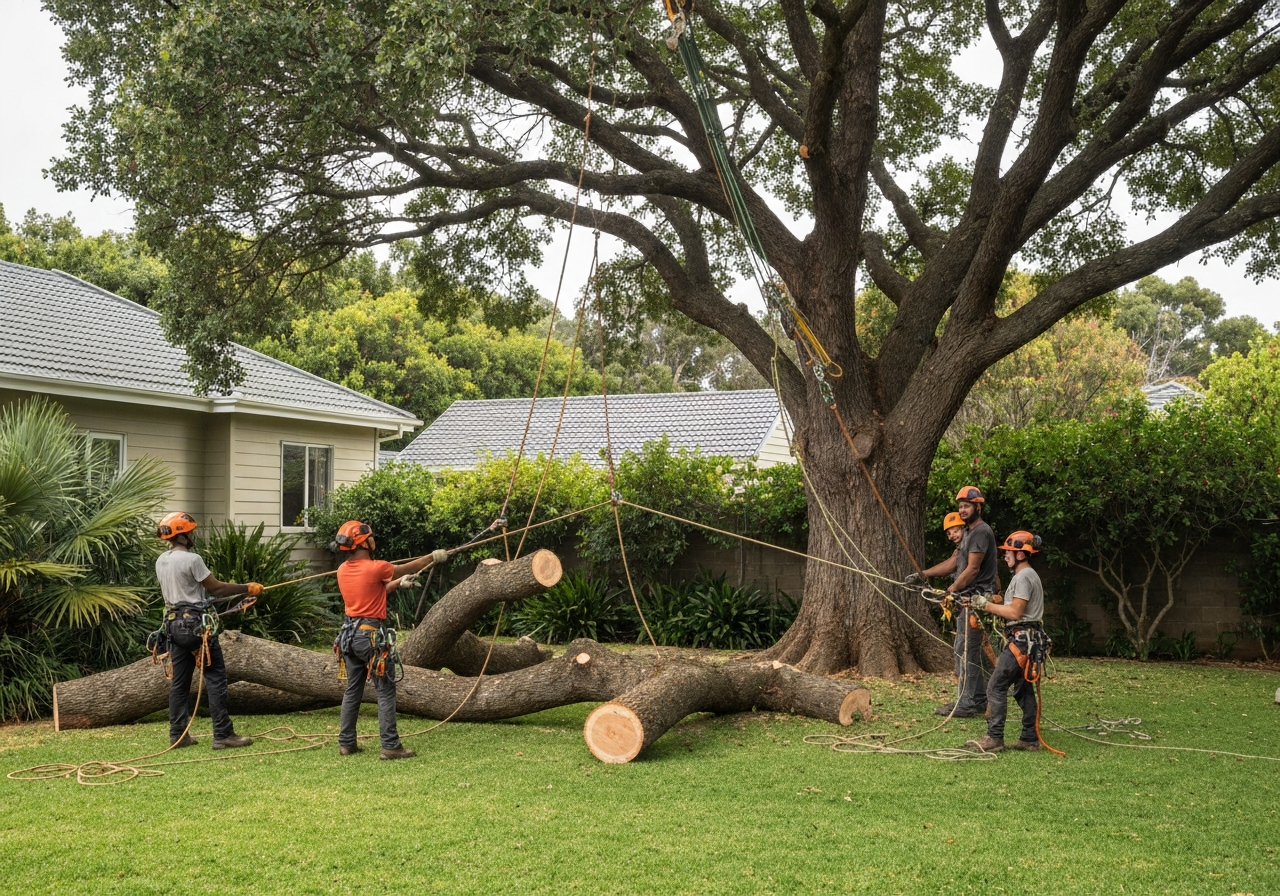
Tree cutting near power lines is a specialised field known as utility arboriculture. Professionals in this trade use tools that minimise risk and maximise precision. A pole saw allows the arborist to reach branches from a distance, while an aerial lift provides a stable platform for working at height. In some cases, a wood chipper is brought in to process the debris on site, leaving the property clean and safe. Stump grinding is often included in the service to remove the stump below ground level, preventing regrowth and trip hazards.
Practical Steps for Property Owners
If you notice a tree on your property that is growing too close to a power line, the first step is to contact a qualified line clearance crew. Do not attempt to trim the tree yourself, even if the branches seem out of reach. Instead, arrange for a tree risk assessment from a reputable tree felling service. They will inspect the site, identify any hazards, and provide a quote based on the tree's size, location, and species. This is far safer and often more cost-effective than dealing with an emergency after a branch has already caused damage.
In Cape Town, the combination of dense suburbs and overhead electricity cables means that many homeowners face this issue at some point. The City of Cape Town has published guidelines on vegetation management, but the responsibility for maintaining safe clearance usually falls on the property owner. By working with an experienced arborist, you ensure compliance with local by-laws and reduce the risk of power outages or accidents. Regular maintenance, such as annual pruning, is much simpler than waiting until the tree is dangerously close to the wires.
What to Expect During a Professional Tree Cutting Job
When you hire a team for tree cutting near power lines, the process typically follows a clear sequence. First, the arborist performs a site inspection and marks the safety zone around the power lines. The crew then sets up the necessary equipment, which may include an aerial lift or a ladder for smaller jobs. The actual cutting is done using a chainsaw or pole saw, with the operator wearing insulated gloves and boots. Branches are lowered carefully to avoid contact with the lines, and the debris is fed into a wood chipper or removed manually.
After the main cutting is finished, the team will often grind the stump to below ground level. Stump grinding prevents the tree from regrowing and eliminates a potential tripping hazard. The area is then cleaned up, leaving the property looking tidy. This level of service is standard for professional tree felling companies in the Cape Town area. They are insured, trained in occupational health and safety, and familiar with the specific challenges of working in the local environment, from the windy Cape Peninsula to the more sheltered valleys of the eastern Cape.
Why DIY Tree Cutting Near Power Lines Is a Bad Idea
It might be tempting to save money by cutting a few branches yourself, especially if the tree seems small or the power line is not directly overhead. But the reality is that electricity can jump across gaps, especially in damp conditions. A ladder placed near a live wire can become a conductor, and a chainsaw that touches the line can electrify the entire tool. Even if you survive the initial shock, the fall from a ladder or tree can cause catastrophic injuries. The phrase "it's not worth the risk" is not just a cliche - it is a literal truth in utility arboriculture.
Professional arborists spend years learning how to assess and manage these risks. They carry specialised insurance, use equipment that is tested regularly, and work in teams that can respond to emergencies. They also understand the local regulations, which vary between municipalities. In the Western Cape, for example, the rules around tree cutting near power lines are enforced by both the local government and Eskom. A homeowner who violates these rules can face legal action, especially if the work causes an outage or damages property.
Conclusion
Tree cutting near power lines is a high-stakes job that demands respect for both the tree and the electricity running through the wires. For property owners in Cape Town, the safest and most effective approach is to hire a qualified arborist who understands the local conditions and regulations. By doing so, you protect your family, your property, and the broader community from the dangers of electrocution and power failure. Whether you need a simple trim or a full tree felling with stump grinding, professional help is the only sensible choice.